
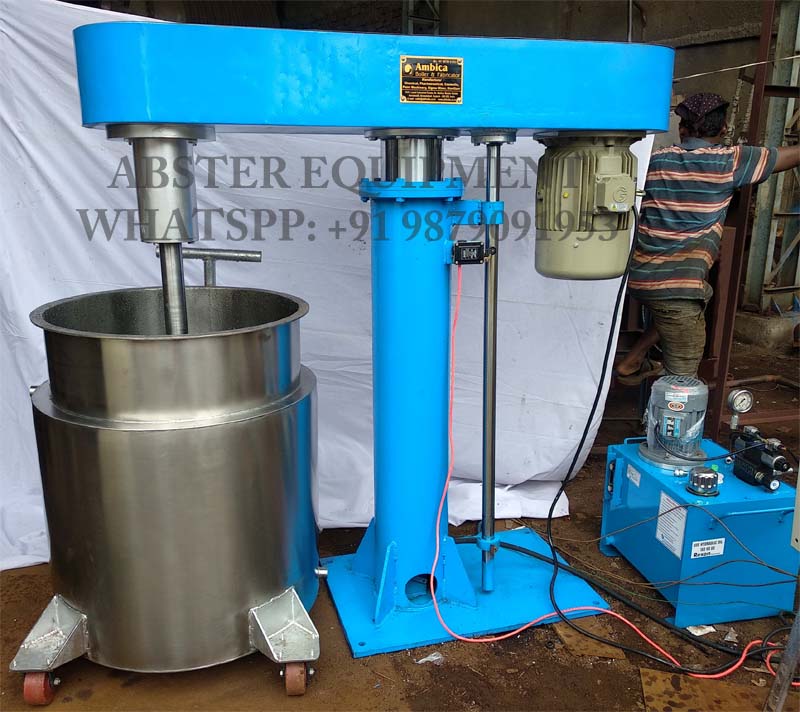
Ideal for water based Acrylic paint , paint dispersing, Paint Manufacturing
The operating principle of a high-speed disperser revolves around the generation of intense shear forces through the rapid rotation of the dispersing blade or rotor. These shear forces are responsible for breaking down agglomerates and dispersing particles within the mixing medium. The key mechanisms involved in this process include:
1. Mechanical Shear: The high-speed rotation of the dispersing blade creates mechanical shear forces that physically break apart agglomerates and disperse particles. This shearing action is particularly effective for solid-liquid and solid-solid dispersions.
2. Hydraulic Shear: As the dispersing blade rotates, it creates turbulence and high-velocity flow patterns within the mixing medium. This hydraulic shear contributes to the dispersion of particles by subjecting them to intense shear stresses and collisions.
3. Cavitation: In certain cases, the high-speed rotation of the dispersing blade can induce cavitation, which involves the formation and subsequent collapse of microscopic bubbles within the liquid medium. The implosion of these bubbles generates localized high-pressure zones that further aid in the dispersion process.
4. Centrifugal Force: The rapid rotation of the dispersing blade also generates centrifugal forces that drive the mixture towards the walls of the mixing vessel, promoting efficient circulation and ensuring thorough mixing and dispersion.